
Sherman County Court Records After Arrest
The arrest-to-court pathway in Sherman County starts at the jail and then moves to the clerk and courts. The jail records custody, booking, bond, and hold information. The prosecutor and the court decide what formal charges move forward. Once a complaint, information, or indictment is filed, the court record becomes the main source for charge status, hearings, motions, bond orders, dispositions, and sentence information.
Booking detail and custody detail belong on the jail side, so current custody questions fit Sherman County jail inmate records. Booking photos fit the Sherman County jail mugshots path. Court records after a jail arrest are different: they show what the prosecutor filed and what the court did with the case. The charge text can change after arrest, so a booking label should not be treated as a conviction or final court outcome.
Sherman County Clerk Record Path
The local court-record path runs through the Sherman County and District Clerk. The official clerk page names Laura Rogers as County and District Clerk, lists P.O. Box 270, Stratford, TX 79084, phone 806-366-2371, and email laurarogers@co.sherman.tx.us. It states that official records are available in and from the Clerk's Office only. The same county material links court case records to iDocket and public or land records to Kofile.
Office hours in the research are Monday through Thursday 8 AM to 5 PM and Friday 8 AM to noon, with the office open during lunch. If iDocket does not show a case after a recent jail arrest, call the clerk and ask whether the case is too new, filed under a different spelling, sealed, in a different court, or not yet filed. Court records after arrest often lag behind jail booking because paperwork, prosecutorial review, and filing must happen first.
The county clerk source page is the local access point for filed court records after a Sherman County arrest.
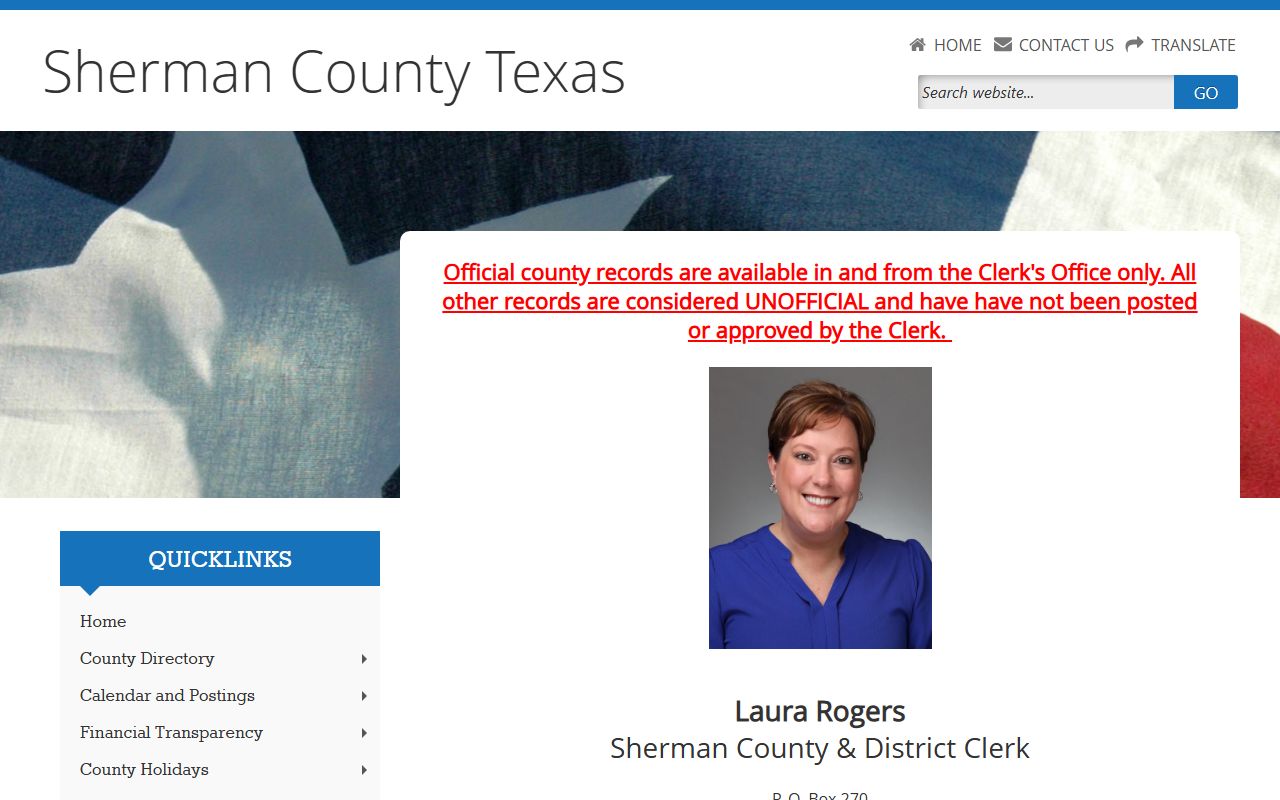
The screenshot matches the official route because it shows the clerk page that points users toward iDocket and states the official-records limitation.
Search Court Records After Arrest
Sherman County links court case records to iDocket. The fetched public iDocket landing page did not expose detailed form fields during research, so exact Sherman County field labels should not be invented. A practical search starts with the defendant's full name, alternate spelling, and any case number or citation number supplied by the jail, clerk, court notice, bond paperwork, or attorney.
- Confirm current custody or release through Sherman County Jail if the arrest is very recent.
- Use the clerk's court-record path and iDocket link for filed charges and case status.
- Search by defendant name or case number if the portal supports those options.
- Open the case record and compare arrest charge language with filed charge language.
- Call the clerk at 806-366-2371 if no case appears or if the record needs official verification.
The iDocket source is a vendor portal linked from the official Sherman County clerk pages.

Because detailed search fields were not inspectable, the safer record path is to combine iDocket searching with clerk confirmation.
Sherman County Case Search Fields
The court case-search field table is limited by the source. Sherman County links iDocket for court case records, but the research did not verify the live search labels inside the portal. That means the table should document the verified limitation instead of promising fields that may not exist or may change.
| Field Label | Type | Required | Options or Notes |
|---|---|---|---|
| Not inspectable | n/a | n/a | iDocket is linked by Sherman County, but detailed public form fields were not exposed in fetched research. |
| Defendant name | Likely search input | Unknown | Use full name and alternate spelling when searching or calling the clerk. |
| Case number | Likely search input | Unknown | Use if shown on bond paperwork, court notices, or clerk correspondence. |
| Court or case type | Unknown | Unknown | Ask the clerk if the case may be in district, county, or justice court. |
Sherman County Arrest Charging Records
After a Sherman County jail arrest, the charge record begins to take shape when a charging document is filed. A complaint may begin certain proceedings. An information is a prosecutor-filed charging document often used in non-indictment cases. An indictment is a grand jury charging document, commonly tied to felony prosecution. The exact document matters because it tells the reader whether the court case is still an accusation, has been amended, or has reached a later stage.
| Document | Who Uses It | What It Means |
|---|---|---|
| Complaint | Officer, complainant, or prosecutor process | A sworn allegation or initiating document used in some criminal matters. |
| Information | Prosecutor | A prosecutor-filed charge used for many cases that do not require indictment. |
| Indictment | Grand jury | A felony charging document returned after grand jury review. |
Felony prosecution is tied to the 69th Judicial District, which official district court sources identify as serving Moore, Dallam, Hartley, and Sherman counties. State Bar information lists Erin Lands Anchondo at the 69th Judicial District Attorney's Office, 715 S. Dumas Ave, Dumas, TX 79029, phone 806-935-5654. Misdemeanor and local county matters may involve County Attorney David Holmes, whose Sherman County page lists phone 806-366-2270.
Sherman County Charge Status
Charge status is one of the main reasons to search court records after a jail arrest. A jail booking charge may be based on arrest paperwork, a warrant, or an initial allegation. The court record may later show that the charge was filed, amended, reduced, enhanced, dismissed, or resolved by plea, trial, deferred adjudication, or another disposition. A disposition is the current or final court outcome.
| Status | What It Means |
|---|---|
| Pending | The case or charge remains open and has not reached final disposition. |
| Filed | The prosecutor, complainant, or court process has initiated the case. |
| Indicted | A grand jury has returned a felony charging document. |
| Amended | The charge or allegation changed after the first filing. |
| Reduced | The charge was lowered to a lesser offense or level. |
| Dismissed | The charge ended without a conviction on that charge. |
| Disposition | The current or final outcome, such as conviction, dismissal, acquittal, or plea. |
Sherman County Bond Records
Bond after a Sherman County arrest begins with the jail and court process. Texas Code of Criminal Procedure Chapter 17 governs bail concepts, including personal bond. The jail may know whether bond has been set, whether a hold blocks release, and whether another agency is involved. The court record may show bond orders, bond changes, and conditions after the case is filed.
| Bond Type | How It Works |
|---|---|
| Cash bond | Money is paid to secure appearance, with refund rules depending on court and case outcome. |
| Surety bond | A licensed bail bond company posts bond for a fee and takes responsibility for appearance terms. |
| Personal or PR bond | Release is based on a written promise and conditions rather than full cash payment. |
| No-bond hold | Release is not available until a court changes the hold or another agency clears it. |
No official Sherman County online bond payment page or local bond schedule was located. Call Sherman County Jail before traveling, confirm the exact bond amount, ask what payment methods are accepted, and ask whether an out-of-county warrant, parole hold, federal hold, or immigration detainer would block release.
Justice Court Arrest Records
Lower-level criminal and traffic-related matters may route through Sherman County Justice Court. The official Justice Court page lists Judge Brenda Acker, clerk Bre Rosales, phone 806-366-5645, mailing address P.O. Box 342, Stratford, TX 79084, and hours Monday through Thursday 8 AM to 5 PM and Friday 8 AM to noon. Justice Court is a useful check when the matter is a citation, Class C issue, or lower-level court event rather than a district-court felony.
No official active-warrant search or public warrant list was located for Sherman County. A bench warrant is a court warrant, often issued after failure to appear. A capias is Texas court process that can order arrest after a case event or charging step. If a warrant led to the arrest, contact may need to run through the sheriff, the clerk, Justice Court, or an attorney depending on who issued it.
Sherman County Charges vs Convictions
A charge is not a conviction. This distinction is central to court records after a jail arrest. An arrest can lead to a booking record, and a filed charge can open a case, but the person is not convicted unless there is a guilty plea, verdict, or qualifying final outcome. Public records can show accusations that never become convictions.
| Point | Charge | Conviction |
|---|---|---|
| Stage | Accusation after arrest or filing | Outcome after plea, verdict, or final adjudication |
| Proof | Based on probable cause or charging decision | Requires the legal standard for conviction |
| Record risk | May remain public unless sealed, restricted, or expunged | Often remains public unless later relief applies |
Sealed and Expunged Arrest Records
Texas Code of Criminal Procedure Chapter 55 covers expunction, which can remove qualifying arrest records from public access by court order. Nondisclosure is different from expunction and limits public disclosure in some situations rather than destroying the record. Texas Government Code Chapter 411 governs criminal-history record information, including separate DPS records that are not the same as a county jail booking or clerk case file.
| Issue | Sealed or Nondisclosed | Expunged |
|---|---|---|
| Public access | Restricted from many public searches | Removed or treated as not existing under the court order |
| Law-enforcement access | May still exist for limited users | Very limited, depending on the order and statute |
| How it happens | Requires qualifying law and court action | Requires qualifying law and a court expunction order |
Important: Criminal-history records cannot be used for FCRA-covered screening unless the user follows consumer-reporting law.
Restricted Sherman County Court Records
Some court records after a jail arrest may be limited, delayed, or redacted. Juvenile records, sealed cases, expunged arrests, medical or victim information, security-sensitive law-enforcement details, and active-investigation material may not be available to the public. Texas Government Code Chapter 552 gives the broad public-information framework, but it also works with exceptions and confidentiality laws.
When a case cannot be found online, the next step is not an unofficial database. Call the clerk, confirm the court, and ask whether the case is too new, sealed, filed under a different name, or outside the court being searched. For state prison custody after sentencing, use TDCJ. For federal or immigration custody, use BOP or ICE. Court records after arrest answer the filed-charge question, not every custody question.